
Recent amendments to the Road Traffic Safety Act in 2023 have expanded the authority of traffic police regarding the confiscation of vehicles due to committed offenses. This change has understandably raised concerns among drivers, as many rely on their vehicles for daily activities. Prior to the 2023 amendments, traffic police were not authorized to confiscate vehicles. Officers could only seize documents suitable for proving unlawful behavior. These documents could be temporarily held by the police unit for up to 24 hours. After this period, they had to be promptly returned to the individual from whom they were seized. Therefore, questions arise: when can the police confiscate a vehicle, and is it returned afterward?
When can a vehicle get confiscated?
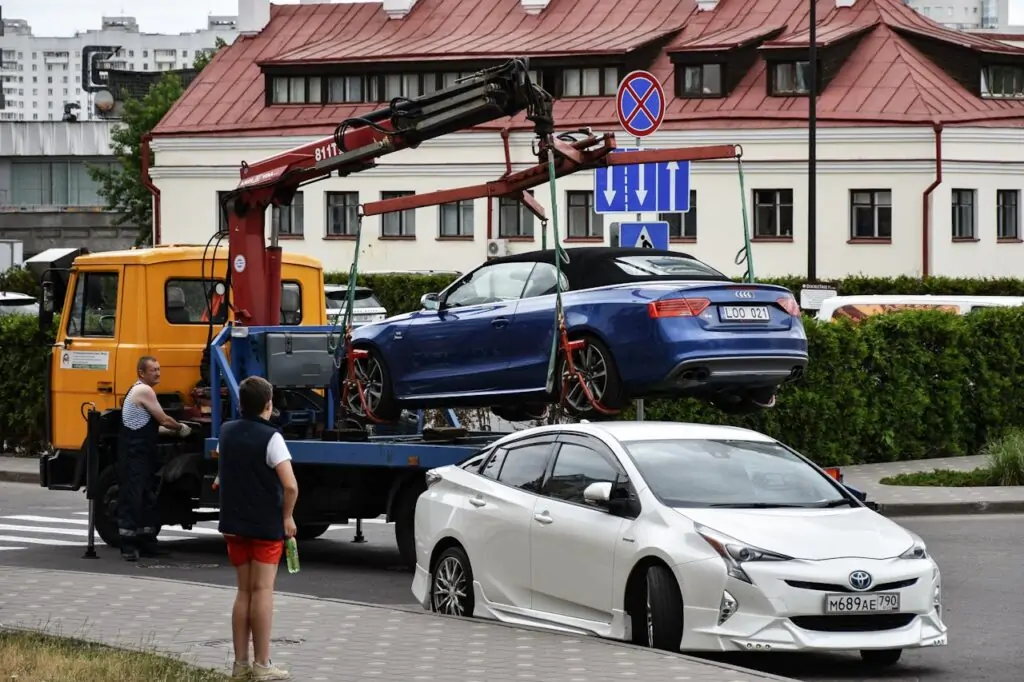
Although traffic police now have the authority to confiscate vehicles, this power is not unlimited. Confiscation is both an authority and a legal obligation for officers. They MUST confiscate a vehicle if they determine that legal conditions are met.
The vehicle will be confiscated from the perpetrator of a serious traffic offense who has been legally convicted of serious traffic offenses in the last two years.
The following groups of misdemeanors are considered serious traffic misdemeanors:
1. Violent driving
- driving that is in gross violation of traffic rules;
- driving in which the driver shows no regard for the safety of other road users;
- passing through a traffic light two or more times when passing is prohibited within 10 minutes;
- overtaking a column of vehicles by moving across or along a continuous line separating the lanes in each direction;
- driving a vehicle on a built-up road at a speed that is 90 km/h higher than the permitted speed;
- driving a vehicle on a road outside a settlement at a speed that is 100 km/h higher than the permitted speed and
- driving while under full intoxication.
2. Driving license, ban and suspension
- driving a motor vehicle without a driver's license issued for any category of motor vehicles, or without a driver's license issued after its revocation due to negligent and improper driving;
- operating a tourist train without a driver's license and a special permit for operating a tourist train, except in cases where the driver's license or special permit has expired;
- operating a tram without a driver's license and a special permit for operating a tram, except in the case when the driver's license, or special permit, has expired;
- driving a vehicle while while the driver is excluded from traffic;
- driving a vehicle while while the vehicle is excluded from traffic;
- driving a motor vehicle, i.e. a tram, during the duration of the protective measure i.e. the safety measure of the ban on driving a motor vehicle and
- conducting practical training of a driver candidate by a driving instructor for the duration of the protective measure i.e. the safety measure of ban on driving a motor vehicle i.e. if he has lost the right to drive a motor vehicle of a certain category, i.e. his driving license has been revoked.
3. Alcohol and psychoactive substances
- Taking action in a state heavy and very heavy intoxication or refusing to submit to testing for the presence of alcohol or psychoactive substances in the body. This applies to:
- the driver who is driving the vehicle;
- a person supervising a driver with a probationary driver's license;
- a driving instructor who is providing practical training;
- a driver candidate during practical training or taking a driver's exam and
- examiner on the practical part of the driving test.
4. Speeding
- driving on a built-up road at a speed that is more than 70 km/h to 90 km/h higher than the permitted speed;
- driving outside a settlement at a speed that is more than 80 km/h to 100 km/h higher than the permitted speed;
- driving outside a settlement at a speed that is 70 km/h higher than permitted if the driver is operating a bus with a trailer, a city bus and a bus that has standing space in addition to the seats;
- moving in a "slow traffic" zone at a speed that is more than 50 km/h higher than the permitted speed and
- moving in a "30" zone and "school" zone at a speed that is more than 60 km/h higher than the permitted speed.
5. Movement on the road
- failure to stop a vehicle in front of a pedestrian crossing where there is at least one pedestrian, when a traffic light or a sign from an authorized official prohibits passage пролаз забрањен;
- failure to stop before crossing a road over a railway line if the traffic closure device is lowered or has started to lower, or if light or sound signals are given warning that the device will start to lower, or that a train is approaching the road over a railway line, in cases where a child under 12 years of age is being transported in the vehicle or driving a bus carrying passengers, or another vehicle used for public passenger transport;
- overtaking i.e. going around a vehicle that has stopped, or is stopping to let a pedestrian pass at a pedestrian crossing;
- overtaking a convoy of escort vehicles and
- faliure to yield to and not allowing or preventing an escort vehicle to pass or overtake and failure to comply with orders given by persons in the escort.
6. Traffic accident and other situations
- failure to stop the vehicle, i.e. failure to notify the police and leaving the scene of a traffic accident before the arrival of the police and the completion of the scene investigation, if the person is a participant in a traffic accident in which a person sustained bodily injuries, i.e. died, or major material damage occurred;
- driving a vehicle at night on an unlit part of the road without lights or front position light on;
- transporting a child under 12 years of age in the driver's seat;
- transporting a child under 12 years of age in a seat not intended for seating, contrary to the rules of the law on the transport of persons in vehicles and
- driving a light electric vehicle on a road or motorway and transporting another person under the age of 14.
Will the confiscated vehicle be returned?

This depends on the misdemeanor court. The traffic police can only temporarily seize a vehicle and it is returned no later than upon completion of the proceedings before the competent misdemeanor court, UNLESS THE MISDEMEANOR COURT MAKES A DECISION TO PERMANENTLY CONFISCATE THE VEHICLE as an object that was used or intended for the commission of a misdemeanor.
The return of a temporarily seized vehicle may be requested before the legally specified deadline if the vehicle is essential for the person from whom it was seized.
The costs incurred as a result of storing a temporarily seized vehicle shall be borne by the person from whom it was seized.
If you have any questions regarding the office's practice areas or the posts on this website, please feel free to contact us. All communication with the office is protected by the obligation of attorney-at-law confidentiality.